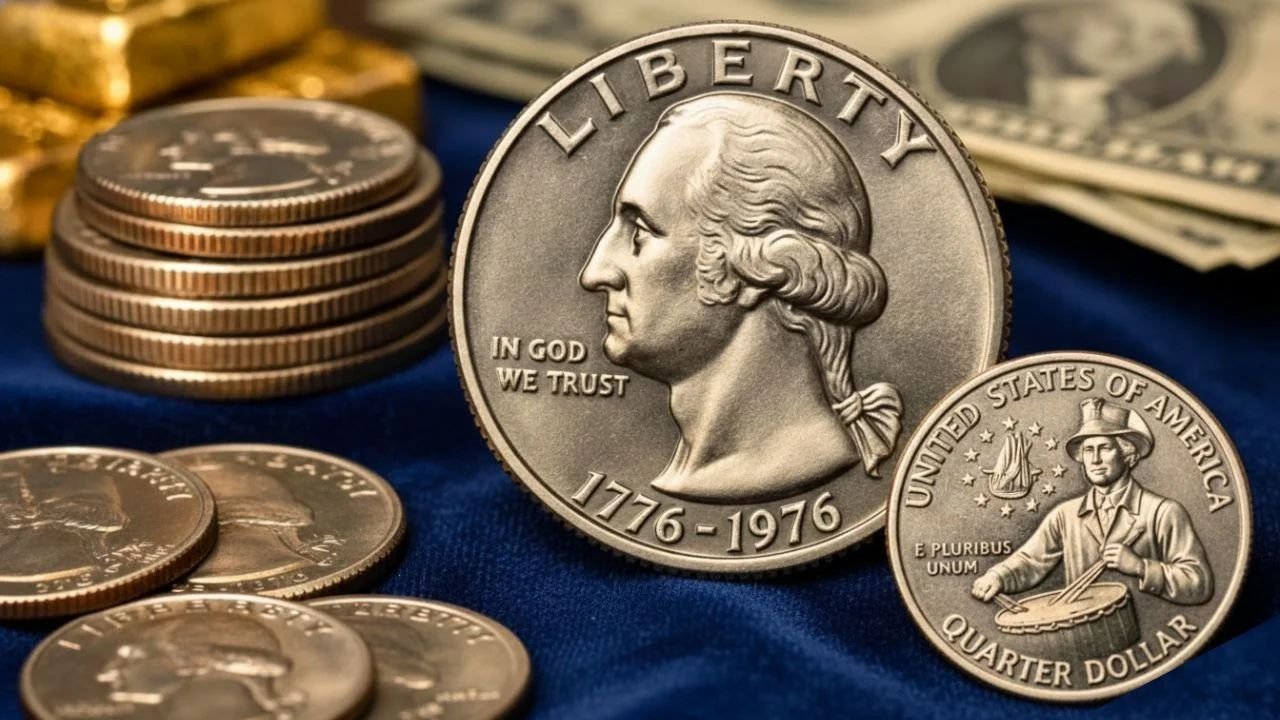
The 1776–1976 Bicentennial Quarter is one of the most recognizable and collectible coins in modern U.S. numismatics. Minted to commemorate the 200th anniversary of American independence, this special quarter stands apart from standard issues with its unique dual-date and colonial drummer reverse design. While most Bicentennial Quarters are common and worth only face value, certain rare errors and silver-clad editions have captivated collectors and investors alike. Understanding these variations and their market value is key for anyone interested in U.S. coin collecting.
Historical Significance of the Bicentennial Quarter
The United States Mint produced the Bicentennial Quarter during 1975 and 1976 as a tribute to the nation’s 200-year anniversary. Unlike typical quarters, the Bicentennial coin bears the dual date “1776–1976” and features a specially designed reverse depicting a colonial drummer boy, a torch, and 13 stars representing the original colonies. Designed by Jack L. Ahr, this design was intended to honor the revolutionary spirit of America while maintaining the familiar obverse portrait of George Washington. These quarters were struck in both regular circulation and special collector editions, creating opportunities for both everyday coin users and numismatic enthusiasts.
Understanding the Coin’s Composition

Most Bicentennial Quarters were produced in the standard copper-nickel clad composition, suitable for circulation. These coins are lightweight and exhibit the typical two-tone color with a copper core and nickel outer layers. In addition, the U.S. Mint released a special 40% silver version for collectors, included in proof and uncirculated sets. Silver editions are heavier, have a distinct metallic sheen, and are inherently more valuable due to their precious metal content. Whether in copper-nickel or silver, the coin’s dual-date and distinctive reverse design make it instantly recognizable and highly collectible.
Spotting Rare Errors
Error coins occur when a misstep happens during the minting process, and they are highly sought after by collectors. Common Bicentennial Quarter errors include:
- Doubled Dies: Letters or numbers appear blurry or doubled due to misaligned stamping.
- Off-Center Strikes: The design is not properly aligned on the coin blank, resulting in an uneven image.
- Wrong Planchet Strikes: Coins struck on an incorrect metal blank, such as a dime or nickel planchet, are extremely rare.
These errors are limited in number, making them highly desirable. Depending on condition and rarity, some error coins can fetch hundreds or even thousands of dollars at auction.
Condition and Grading
A coin’s condition dramatically affects its value. Collectors use grading scales to evaluate wear, luster, and overall appearance, ranging from “Poor” to “Mint State.” Coins that retain sharp details, original shine, and minimal handling marks are the most valuable. Even a common copper-nickel Bicentennial Quarter can achieve a premium price if it is uncirculated and pristine. Proof and silver-clad versions, especially those in perfect condition, command higher prices due to both rarity and metal content.
Bicentennial Quarter Value Range
- Common Circulating Coins: Typically worth face value ($0.25).
- Uncirculated Copper-Nickel Coins: Can range from $1 to $5 depending on condition.
- Error Coins: Values vary widely from $50 to several thousand dollars, depending on the type of error and collector demand.
- 40% Silver Collector Editions: Usually valued between $10 and $50 for lower grades, with high-grade specimens fetching $100 or more.
Collector Tips for Success
- Start with What You Have: Examine old coin jars, piggy banks, or inherited collections. Hidden treasures may be waiting in everyday change.
- Use Magnification: A magnifying glass or jeweler’s loupe helps identify doubled dies, off-center strikes, or other small anomalies.
- Handle with Care: Always hold coins by the edges to avoid fingerprints and surface damage.
- Protect Your Collection: Store coins in soft plastic holders or coin albums to maintain condition and value.
Frequently Asked Questions
Q: Are all Bicentennial Quarters from 1975 or 1976?
A: Yes. Although the coins display the dual date “1776–1976,” production occurred in both 1975 and 1976. No single-date quarters from these years were issued for the Bicentennial series.
Q: How can I identify a silver Bicentennial Quarter?
A: Silver quarters are 40% silver, heavier than standard coins, and have a uniform silver color across the edge, unlike copper-nickel coins which show a brown stripe in the center.
Q: What is a “doubled die” error?
A: A doubled die occurs when the die used to strike the coin has misaligned design elements, creating a doubled image on letters, numbers, or motifs. These are rare and valuable.
Q: Where can I find valuable Bicentennial Quarters?
A: Look in pocket change, rolls of coins from banks, estate sales, or collectible coin shops. Exceptional finds often appear in unexpected places.
Q: How do I determine my coin’s grade?
A: Grading involves evaluating wear, luster, and detail. Beginners can compare their coins to official guides, while professional grading services provide authentication and certification for high-value pieces.
The Enduring Appeal
The 1776–1976 Bicentennial Quarter is more than a commemorative coin; it is a piece of American history, a collectible with both artistic and monetary value, and a testament to the country’s independence. Whether you are a casual collector, a dedicated numismatist, or an investor, understanding its varieties, errors, and grading nuances opens the door to a rewarding collecting experience. Even a coin found in your change today could be a small yet valuable piece of history waiting to be appreciated.